

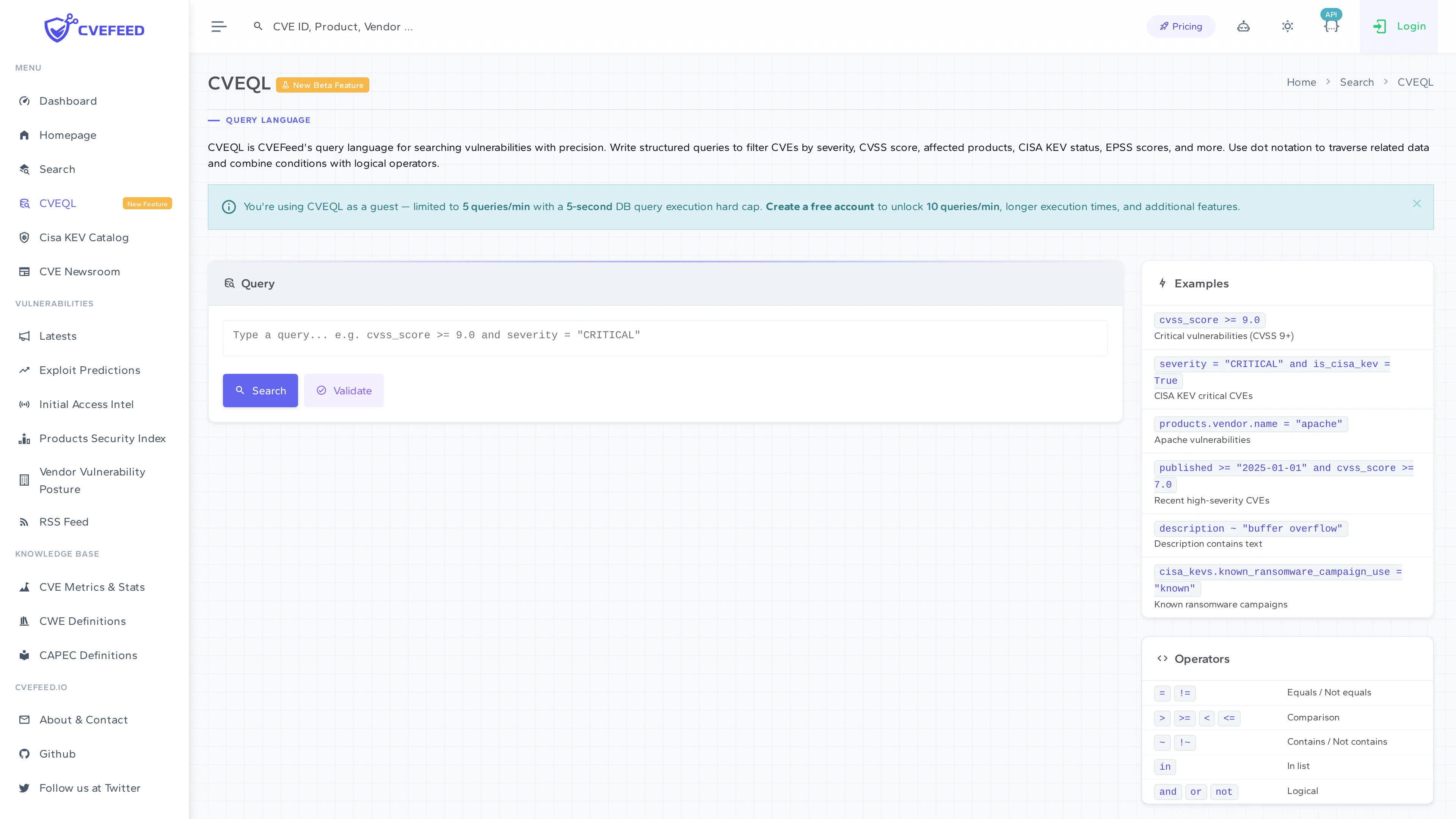
CVEQL — Query Language
CVEQL (CVE Query Language) is CVEFeed.io’s structured query language for searching vulnerabilities with precision. Write queries that combine severity, CVSS score, affected products, CISA KEV status, EPSS scores, and more — using dot notation to traverse related data and logical operators to combine conditions.
CVEQL is available to all users, including unauthenticated guests (with lower rate limits and query timeouts).
Writing Queries
Section titled “Writing Queries”Queries follow the pattern field operator value, combined with the and and or logical operators and grouped with parentheses. There is no standalone not — negate a condition with !=, !~, or one of the not in / not startswith / not endswith operators.
Queryable Fields
Section titled “Queryable Fields”| Field | Type | Description |
|---|---|---|
id | string | CVE ID (e.g., "CVE-2024-3400") |
description | string | Full vulnerability description text |
published | date | Publication date |
last_modified | date | Last modification date |
status | string | CVE status value |
cvss_score | number | CVSS score (0.0–10.0) |
severity | string | Severity level — "CRITICAL", "HIGH", "MEDIUM", "LOW", plus "NA" and "NONE" for CVEs with no CVSS score |
is_remote | boolean | Whether the vulnerability is remotely exploitable |
is_cisa_kev | boolean | Whether it appears in the CISA KEV catalog |
has_epss | boolean | Whether EPSS scores are available |
has_category | string | Vulnerability category id (e.g., "injection", "memory-corruption") |
Category Values
Section titled “Category Values”has_category matches a closed taxonomy of 15 ids. Ids are hyphenated, and a value outside this list matches nothing rather than raising an error:
injection, memory-corruption, race-condition, xee, xss, csrf, ssrf, path-traversal, authentication, authorization, cryptography, information-disclosure, misconfiguration, supply-chain, denial-of-service
Each CVE is classified into at most one of these categories from its description, and many CVEs carry no category at all.
Related Data (Dot Notation)
Section titled “Related Data (Dot Notation)”You can query related data using dot notation:
| Field | Description |
|---|---|
products.name | Name of an affected product |
products.vendor.name | Vendor name of an affected product |
products.vendor.part | CPE part of the vendor ("application", "operating system", "hardware") |
cwes.id | CWE identifier |
cwes.name | CWE name |
cisa_kevs.vulnerability_name | CISA KEV vulnerability name |
cisa_kevs.date_added | Date added to CISA KEV |
cisa_kevs.due_date | CISA remediation due date |
cisa_kevs.known_ransomware_campaign_use | Known ransomware campaign usage — stored lowercase ("known", "unknown") |
epss_scores.score | EPSS probability score |
epss_scores.percentile | EPSS percentile |
epss_scores.release_date | Date the EPSS score was published |
Operators
Section titled “Operators”| Operator | Meaning |
|---|---|
= | Equals |
!= | Not equals |
>, >=, <, <= | Numeric/date comparison |
~ | Contains (partial text match) |
!~ | Does not contain |
in | Value is in a list |
not in | Value is not in a list |
startswith | String starts with |
not startswith | String does not start with |
endswith | String ends with |
not endswith | String does not end with |
and | Both conditions must match |
or | Either condition must match |
String comparison with =, !=, in, and not in is case-sensitive; ~, !~, startswith, and endswith are not. products.name is the exception — =, !=, ~, !~, in, and not in on it run through PostgreSQL full-text search and ignore case, while startswith and endswith are not supported on that field and silently match nothing.
Example Queries
Section titled “Example Queries”Critical vulnerabilities with a CVSS score of 9.0 or higher:
cvss_score >= 9.0 and severity = "CRITICAL"CISA KEV critical CVEs:
severity = "CRITICAL" and is_cisa_kev = TrueApache product vulnerabilities:
products.vendor.name ~ "apache"Recent high-severity CVEs from 2025:
published >= "2025-01-01" and cvss_score >= 7.0Vulnerabilities with known ransomware campaigns:
cisa_kevs.known_ransomware_campaign_use = "known"Buffer overflow vulnerabilities that contain specific text:
description ~ "buffer overflow"Query Validation
Section titled “Query Validation”Click the Validate button to check your query syntax without executing it. This helps you catch typos or unsupported field names before running the search.
Rate Limits
Section titled “Rate Limits”CVEQL queries are rate-limited per tier:
| Tier | Queries per Minute |
|---|---|
| Anonymous | 5 (with 5-second query timeout) |
| Free | 10 |
| Starter | 20 |
| Pro | 30 |
| Enterprise | 40 |
Authenticated queries get a 10-second query timeout; anonymous queries get 5 seconds.
Every CVEQL search — authenticated or not — is restricted to CVEs published in the last 90 days unless the query itself references published or last_modified. Mention either field anywhere in the query (for example severity = "CRITICAL" and published >= "2000-01-01") to search the full catalog. Each search response includes a default_date_filter boolean: true means the 90-day window was applied, false means your query supplied its own date range.